Add a model
Tensor format
All IceNet-MP models operate on tensors in NTCHW format:
| Dimension | Meaning |
|---|---|
N |
Batch size |
T |
History steps (inputs) or forecast steps (outputs) |
C |
Channels / variables |
H |
Height |
W |
Width |
N and T are the same across all inputs, but C, H, and W may differ per dataset.
For example, with 3 history steps, and 4 forecast steps, each of the k inputs each have shape (N, 3, C_k, H_k, W_k) and the output has shape (N, 4, C_out, H_out, W_out).
Standalone models
A standalone model accepts a dict[str, TensorNTCHW] mapping dataset names to tensors and produces output of shape (N, T, C_out, H_out, W_out).
Each model instance is typically trained to predict a single output, although this is not a hard constraint.
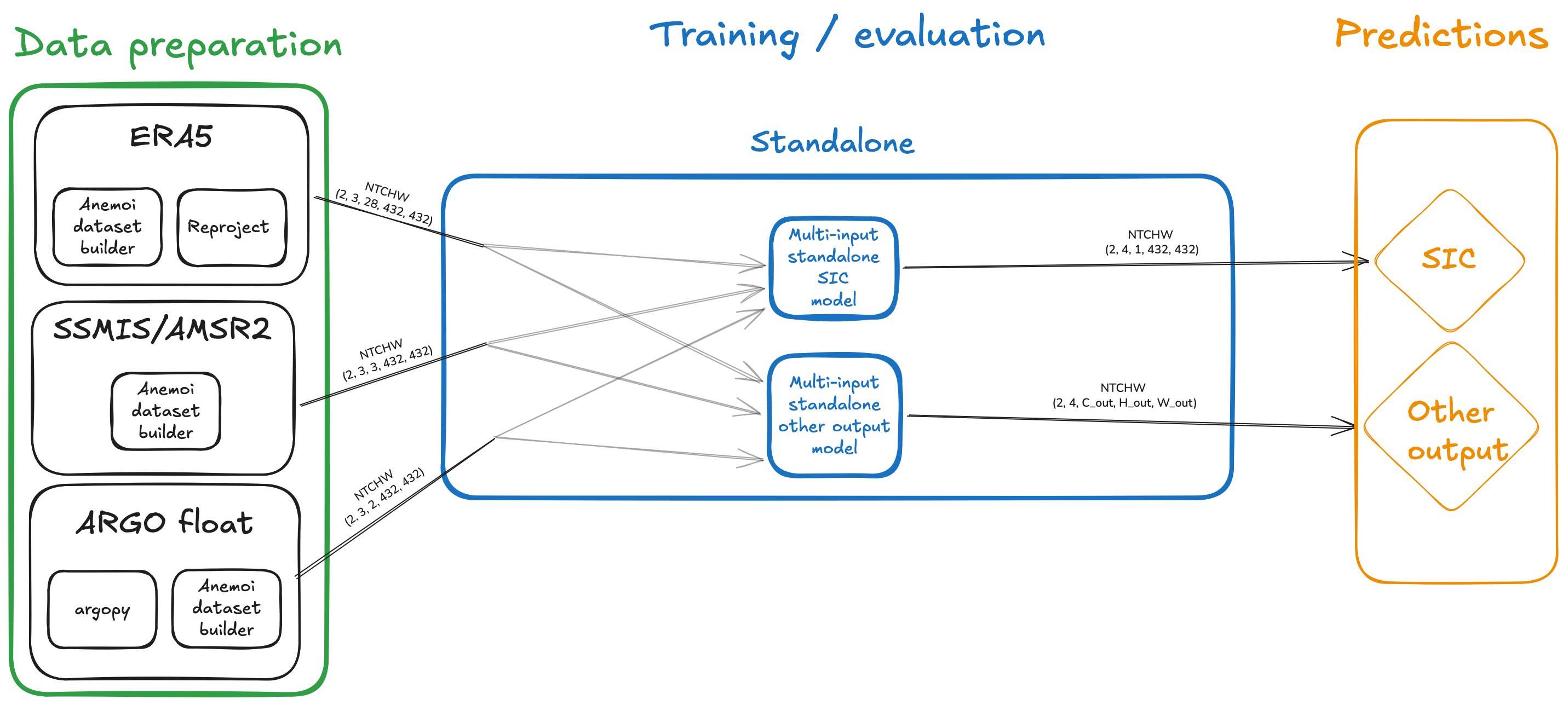
| Pros | All input variables available without transformation. |
| Cons | Combining datasets of different shapes or types must be done inside the model. |
Processor models
A processor model sits inside an encode-process-decode pipeline.
You define a latent space (H_latent, W_latent) and the framework automatically creates one encoder per input and one decoder per output.
- Each dataset-specific encoder maps input
(N, T_history, C_k, H_k, W_k)to(N, T_history, C_k_latent, H_latent, W_latent). - The
kencoded tensors are concatenated to(N, T_history, C_latent, H_latent, W_latent). - The processor maps
(N, T_history, C_latent, H_latent, W_latent)to(N, T_forecast, C_latent, H_latent, W_latent). - Each output-specific decoder maps the processor output,
(N, T_forecast, C_latent, H_latent, W_latent), to(N, T_forecast, C_out, H_out, W_out).
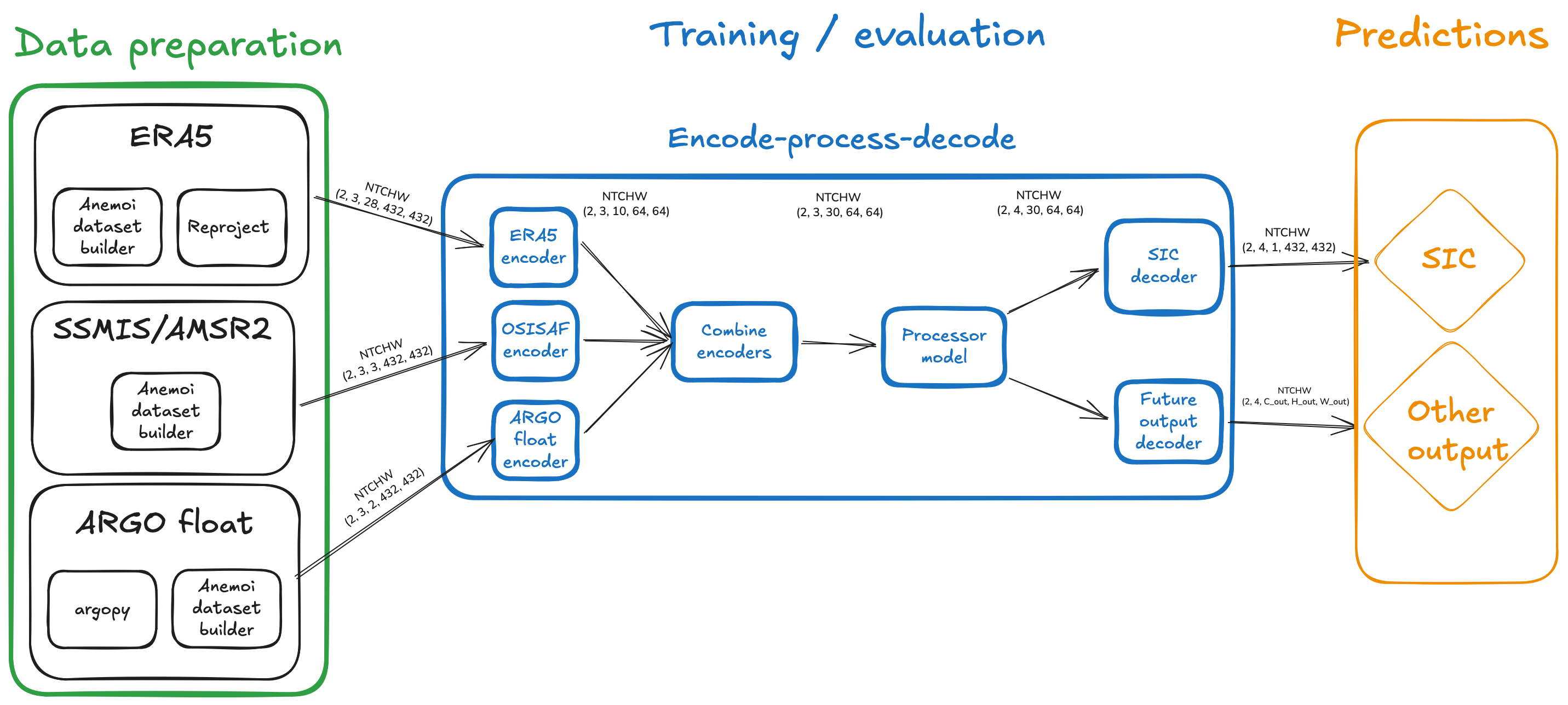
| Pros | Inputs are converted into a common latent space, freeing up the model to learn time evolution. |
| Cons | Latent space representation may lose some spatial correlations present in the inputs. |